
Temperature Tolerance of Glass Hookah: Mastering Heat Resilience

Dec .28.2025
  views

Core keywords: temperature tolerance of glass hookah, thermal shock resistance in hookah glass, heat-resistant hookah base

Among all components of a waterpipe, the temperature tolerance of glass hookah determines both its safety and performance longevity. This property defines how well glass resists rapid heating, cooling, and microfracture stress during each session. Without proper handling, even the most elegant design can fail under uneven heat gradients. For manufacturers and café operators alike, mastering thermal control means preventing accidents and ensuring consistent draw quality.

Understanding the temperature tolerance of glass hookah begins with its composition and continues through daily care. Modern hookah artisans now engineer glass bases and stems using controlled annealing techniques to balance clarity with stability. However, real-world endurance depends less on lab figures and more on everyday discipline—how users manage water temperature, ambient conditions, and post-session cleaning. This process is also essential to maintaining thermal shock resistance in hookah glass under repeated stress.
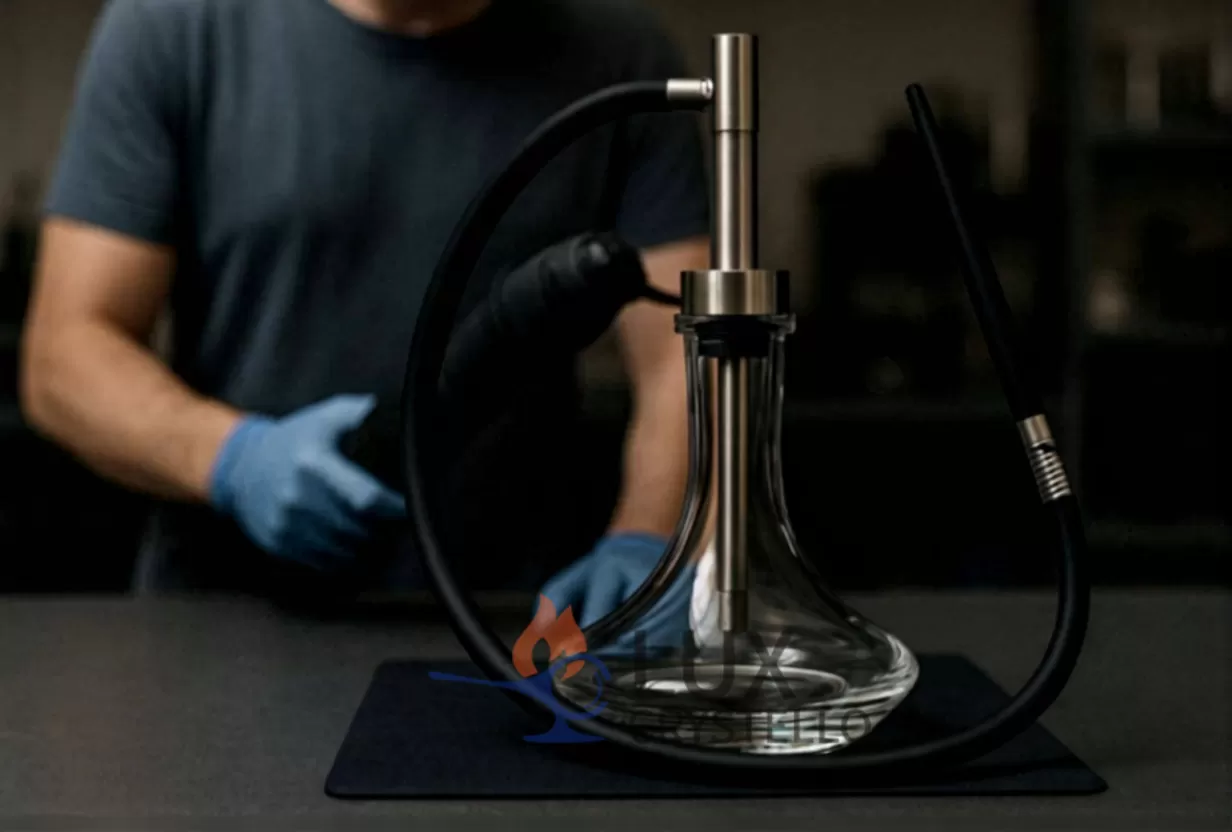

thermal-shock-resistance-in-hookah-glass.jpeg

Material Composition and Structure

Two major glass types dominate the market: borosilicate and soda-lime.

Borosilicate glass features a higher coefficient of thermal resistance and is used in scientific equipment; it tolerates abrupt changes up to 165 °C without cracking.

Soda-lime glass, favored for its aesthetic color options, offers brilliance but demands gentle thermal transitions.

Choosing the right type is crucial for sustaining the temperature tolerance of glass hookah in commercial settings, where repeated cycles of heat exposure and cooling are common. Borosilicate-based systems provide better thermal shock resistance in hookah glass, ideal for high-volume cafés and lounges.

Role of the Hookah Base in Thermal Balance

The heat-resistant hookah base acts as the system’s thermal buffer. Its volume and waterline absorb excess heat from the stem, preventing local hotspots that might induce fractures. To maximize performance:

  • Fill the water to the neck curve—not beyond.
  • Avoid pouring ice water into a recently rinsed warm base.
  • Set the hookah on nonconductive mats to isolate it from cold tabletops.

Consistent handling practices preserve the temperature tolerance of glass hookah, extending equipment lifespan and improving session stability. Over time, this steady approach enhances the thermal shock resistance in hookah glass for professional-grade reliability.

Environmental and Operational Variables

External conditions—drafts, air conditioning, or outdoor humidity—affect cooling rates. Experts recommend gradual heating using controlled charcoal positioning rather than direct flame contact. This incremental approach mitigates stress and enhances thermal shock resistance in hookah glass, allowing the vessel to adapt to environmental variance safely.

By following these methods, users maintain the equilibrium that defines a heat-resistant hookah base, ensuring optimal draw and protection from sudden temperature swings.

temperature-tolerance-of-glass-hookah.jpeg

Cleaning and Defect Prevention

Residue buildup alters heat distribution. Always rinse the glass hookah base with lukewarm water before applying detergent. Avoid abrupt temperature changes while cleaning; microcracks invisible to the naked eye compromise the temperature tolerance of glass hookah over time.

Routine inspection with LED backlighting reveals early flaws before catastrophic breakage occurs. Cleanliness is not just aesthetic—it’s a fundamental aspect of preserving thermal shock resistance in hookah glass.

Expert Craftsmanship and Measured Testing

Glass technologists now employ infrared thermography to evaluate thermal performance across production batches. Uniform wall thickness and precision neck joints are the most reliable predictors of strength.

Artisans who document firing curves and controlled cooling intervals consistently deliver pieces with 30–40% greater durability than uncalibrated counterparts. Such attention to detail ensures every heat-resistant hookah base upholds certified temperature tolerance of glass hookah standards throughout its lifespan.

Verified Performance in Professional Lounges

In high-volume cafés, operators monitor base temperature using infrared scanners during busy shifts. Records show that controlled cooling intervals of 2–3 minutes between sessions drastically reduce fracture incidents. Reliable suppliers now provide certification data on temperature tolerance of glass hookah, confirming compliance with ISO 3585 and comparable thermal shock resistance in hookah glass metrics.

Conclusion

The modern temperature tolerance of glass hookah reflects a synthesis of chemistry, craftsmanship, and care. By respecting heating cycles, cleaning rituals, and verified supplier data, users and professionals protect both safety and aesthetics.

A properly maintained heat-resistant hookah base embodies precision and longevity—proof that durability is not chance, but the result of controlled physics executed daily.

Optimize your setup with precision. Request our expert guide on managing the temperature tolerance of glass hookah, featuring proven thermal shock resistance in hookah glass methods and practical maintenance steps for durability and safety.

FAQ

What is the temperature tolerance of a glass hookah?

The temperature tolerance of glass hookah refers to its ability to withstand sudden changes in temperature without cracking. High-quality borosilicate glass can typically handle rapid temperature differences of up to 165°C, while standard soda-lime glass is more susceptible to thermal shock.

How can I improve the thermal shock resistance of my hookah glass?

To improve thermal shock resistance in hookah glass, use bases made from borosilicate glass, avoid exposing the base to extreme temperature changes (like adding ice to a hot base), pre-warm or pre-cool the glass gradually, and ensure it is free of micro-cracks through careful handling and cleaning.

What makes a hookah base heat-resistant?

A heat-resistant hookah base is typically made from borosilicate glass, which has a low coefficient of thermal expansion. This, combined with uniform wall thickness and proper annealing during manufacturing, allows it to expand and contract evenly under heat stress, preventing cracks.

Can all glass hookah bases handle high heat?

No, not all glass hookah bases can handle high heat equally. Soda-lime glass bases are more common and affordable but have lower temperature tolerance. For frequent use or commercial settings, a heat-resistant hookah base made from borosilicate glass is highly recommended for durability and safety.

Ensure your products are built to last. Contact Luxcrystello Crystal today for heat-resistant glass solutions and expert guidance.

Related News
From Brushwork to Firing: How Hand-Painted Crystal Vases Are Made
Jan .09.2026
A glass painted crystal vase represents a decorative object where material clarity and surface artistry work together to create long-term visual value. Unlike p...
Blue Crystal Washbasin: From Material to Form in Crystal Glass Design
Jan .09.2026
A blue crystal washbasin brings material expression to the forefront of bathroom design, shifting attention from pure function to sensory experience. Unlike cer...
Zodiac Horse Crystal Sculpture as a Symbolic Decorative Art Form
Jan .09.2026
Zodiac horse crystal sculpture represents a fusion of symbolic meaning and refined decorative craftsmanship, making it a popular choice in both personal collect...
Crystal Decanter Molding as a Foundation for Premium Glassware Manufacturing
Jan .09.2026
Crystal decanter molding plays a critical role in how luxury glassware brands achieve consistency, clarity, and scalable quality in today’s competitive beverage...
We use cookie to improve your online experience. By continuing to browse this website, you agree to our use of cookie.

Cookies

Please read our Terms and Conditions and this Policy before accessing or using our Services. If you cannot agree with this Policy or the Terms and Conditions, please do not access or use our Services. If you are located in a jurisdiction outside the European Economic Area, by using our Services, you accept the Terms and Conditions and accept our privacy practices described in this Policy.
We may modify this Policy at any time, without prior notice, and changes may apply to any Personal Information we already hold about you, as well as any new Personal Information collected after the Policy is modified. If we make changes, we will notify you by revising the date at the top of this Policy. We will provide you with advanced notice if we make any material changes to how we collect, use or disclose your Personal Information that impact your rights under this Policy. If you are located in a jurisdiction other than the European Economic Area, the United Kingdom or Switzerland (collectively “European Countries”), your continued access or use of our Services after receiving the notice of changes, constitutes your acknowledgement that you accept the updated Policy. In addition, we may provide you with real time disclosures or additional information about the Personal Information handling practices of specific parts of our Services. Such notices may supplement this Policy or provide you with additional choices about how we process your Personal Information.


Cookies

Cookies are small text files stored on your device when you access most Websites on the internet or open certain emails. Among other things, Cookies allow a Website to recognize your device and remember if you've been to the Website before. Examples of information collected by Cookies include your browser type and the address of the Website from which you arrived at our Website as well as IP address and clickstream behavior (that is the pages you view and the links you click).We use the term cookie to refer to Cookies and technologies that perform a similar function to Cookies (e.g., tags, pixels, web beacons, etc.). Cookies can be read by the originating Website on each subsequent visit and by any other Website that recognizes the cookie. The Website uses Cookies in order to make the Website easier to use, to support a better user experience, including the provision of information and functionality to you, as well as to provide us with information about how the Website is used so that we can make sure it is as up to date, relevant, and error free as we can. Cookies on the Website We use Cookies to personalize your experience when you visit the Site, uniquely identify your computer for security purposes, and enable us and our third-party service providers to serve ads on our behalf across the internet.

We classify Cookies in the following categories:
 ●  Strictly Necessary Cookies
 ●  Performance Cookies
 ●  Functional Cookies
 ●  Targeting Cookies


Cookie List
A cookie is a small piece of data (text file) that a website – when visited by a user – asks your browser to store on your device in order to remember information about you, such as your language preference or login information. Those cookies are set by us and called first-party cookies. We also use third-party cookies – which are cookies from a domain different than the domain of the website you are visiting – for our advertising and marketing efforts. More specifically, we use cookies and other tracking technologies for the following purposes:

Strictly Necessary Cookies
These cookies are necessary for the website to function and cannot be switched off in our systems. They are usually only set in response to actions made by you which amount to a request for services, such as setting your privacy preferences, logging in or filling in forms. You can set your browser to block or alert you about these cookies, but some parts of the site will not then work. These cookies do not store any personally identifiable information.

Functional Cookies
These cookies enable the website to provide enhanced functionality and personalisation. They may be set by us or by third party providers whose services we have added to our pages. If you do not allow these cookies then some or all of these services may not function properly.

Performance Cookies
These cookies allow us to count visits and traffic sources so we can measure and improve the performance of our site. They help us to know which pages are the most and least popular and see how visitors move around the site. All information these cookies collect is aggregated and therefore anonymous. If you do not allow these cookies we will not know when you have visited our site, and will not be able to monitor its performance.

Targeting Cookies
These cookies may be set through our site by our advertising partners. They may be used by those companies to build a profile of your interests and show you relevant adverts on other sites. They do not store directly personal information, but are based on uniquely identifying your browser and internet device. If you do not allow these cookies, you will experience less targeted advertising.

How To Turn Off Cookies
You can choose to restrict or block Cookies through your browser settings at any time. Please note that certain Cookies may be set as soon as you visit the Website, but you can remove them using your browser settings. However, please be aware that restricting or blocking Cookies set on the Website may impact the functionality or performance of the Website or prevent you from using certain services provided through the Website. It will also affect our ability to update the Website to cater for user preferences and improve performance. Cookies within Mobile Applications

We only use Strictly Necessary Cookies on our mobile applications. These Cookies are critical to the functionality of our applications, so if you block or delete these Cookies you may not be able to use the application. These Cookies are not shared with any other application on your mobile device. We never use the Cookies from the mobile application to store personal information about you.

If you have questions or concerns regarding any information in this Privacy Policy, please contact us by email at . You can also contact us via our customer service at our Site.